
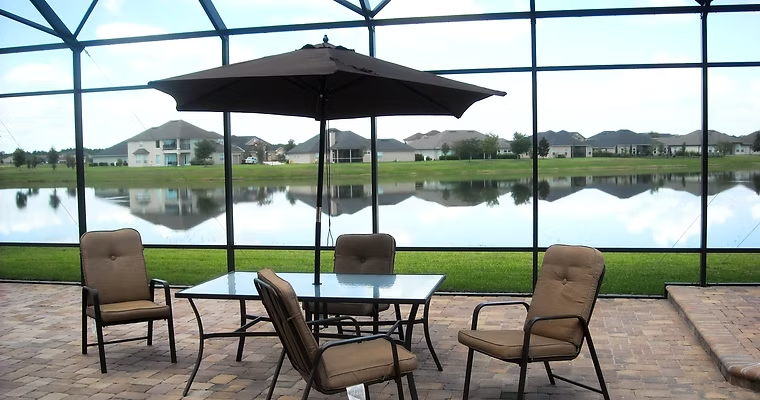
Drive through almost any neighborhood in Jacksonville, Ponte Vedra, or St. Augustine and you’ll see screened lanais and pool cages on house after house. It’s easy to assume this has always been standard, but the screen enclosure as we know it today is really a product of a few specific developments in Florida’s history.
Aluminum, Affordability, and the Post-War Boom
In the decades following World War II, aluminum became far more widely available and affordable for residential construction, and Florida’s building industry put it to use. Aluminum framing was lightweight, resisted the corrosion that Florida’s humidity and salt air are hard on other materials, and could be fabricated efficiently at scale. That combination made screened porches and patio enclosures practical for everyday homes rather than a custom luxury, and aluminum-framed enclosures became an increasingly common sight in Florida neighborhoods built from the mid-20th century onward.
The Rise of the Backyard Pool
As home pool ownership grew across Florida in the decades since, screen enclosures became a natural companion to that trend. A pool cage kept falling leaves, palmetto bugs, and mosquitoes out of the water, cut down on pool maintenance, and gave homeowners a shaded, bug-free space to actually use around the pool rather than just look at it. By the later part of the 20th century, it had become common for a new pool build and a screen enclosure to be planned together rather than as separate projects.
Hurricane Andrew and a Turning Point for Codes
Hurricane Andrew’s impact on South Florida in 1992 exposed how much structural damage under-built construction could sustain in a major storm, and it became a turning point for how Florida approached building codes generally. In the years that followed, the state tightened wind load and structural requirements significantly, and those stricter standards eventually extended to engineered structures like screen enclosures. What had once been a relatively simple add-on structure became something that had to be specifically engineered to withstand real hurricane-force wind loads, with permitting and inspection built into the process.
From Add-On to Expected Feature
By the time codes caught up with the realities of Florida’s storm risk, the screen enclosure had already become deeply embedded in how the state builds outdoor living space. Today it’s less of an upgrade and more of an expected feature on a huge share of Florida homes with a pool or patio, built to current engineering standards rather than the simpler structures of decades past.
What This Means for Your Enclosure Today
That history is part of why a modern, code-compliant enclosure looks different from the screened porches of 40 or 50 years ago. Today’s structures are engineered for your specific wind zone, permitted through your county, and built to standards that trace directly back to lessons learned from storms like Andrew.
Curious what current Florida Building Code means for your specific project? Call Kish Enclosures at (904) 805-4343 or request a free estimate online.